
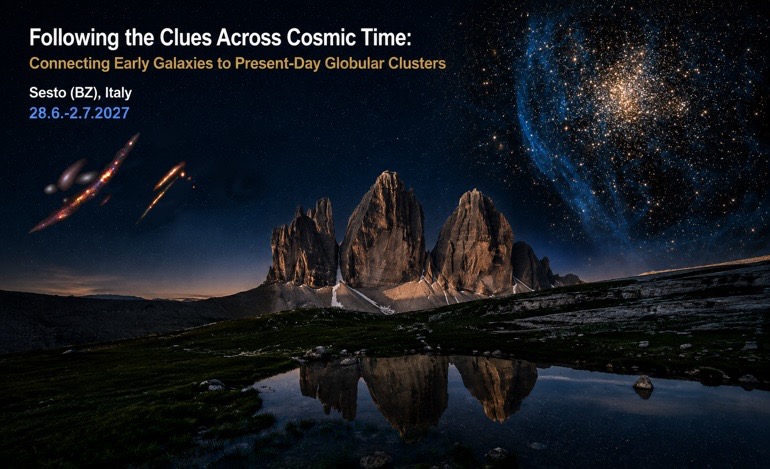
Following the Clues Across Cosmic Time: Connecting Early Galaxies to Present-Day Globular Clusters
Event details
- Date
- June 28, 2027 – July 2, 2027
- Location
- Haus Sexten - Via Dolomiti 45, 39030, Sexten
Scientific Rationale
Globular clusters (GCs) remain one of the most enigmatic witnesses of galaxy assembly history. They are the survivors of extremely efficient star formation in early galaxies. Decoding the information carried out by GCs requires us to retrace their origin and evolution. To achieve this we need to assemble evidence from a broad range of observational and theoretical approaches, spanning the high-redshift Universe, stellar populations, Galactic archaeology, chemical evolution, and numerical simulations. Only by bringing these communities together can we build a coherent picture of how early galaxies formed their stellar content, built metals, interacted with the environment, and what information GCs carry that has survived to the present day.
This conference will provide a forum for researchers across these fields to present the latest discoveries, identify gaps, and define the key advances needed over the coming decade. Together, we will address fundamental questions: When and where did globular clusters form? What do their multiple stellar populations reveal about the physical conditions of their birth? What are the conditions for star formation in early galaxies? How are galaxy bursty phases and chemical enrichment intertwined with cluster star formation and feedback? How does the morphological evolution of galaxies connect with the physics responsible for clustered star formation? How are surviving globular clusters connected to the assembly histories of their host galaxies, and in particular to the formation of the Milky Way?
Over five days, participants will explore these questions by:
- Probing the physical conditions of early galaxies, resolving star formation into stellar clusters and clumps, and trace the bursty cycles and the morphological evolution of galaxies.
- Tracing the role of stellar clusters/clumps have played in reionization, probing the clustered fraction of star formation and star formation propagation within galaxies. Identifying these clustered structures as preferred sites for massive star formation.
- Following the chemical fingerprints of galaxy evolution, tracing star formation conditions and the build-up of metals from the earliest, nearly pristine phases of the Universe to the mature stellar systems observed today.
- Dissecting globular clusters into their stellar components, using detailed chemical abundances, kinematics, and dynamical signatures to reconstruct their formation histories and the environments in which they were born.
- Leveraging the latest results from Gaia and large spectroscopic surveys to reconstruct the assembly history of the Milky Way and uncover its connection to the formation, evolution, and disruption of proto-globular clusters.
- Connecting observations and theory through simulations, combining cosmological models with high-resolution simulations that resolve the complex physics of star formation to link globular clusters, galaxy assembly, and the emerging picture of the high-redshift Universe.
Set against the spectacular settings of Sesto, the workshop will provide an ideal environment for scientific exchange, collaboration, and discussion. Looking ahead, we will explore how forthcoming facilities and surveys—including Euclid, the Nancy Grace Roman Space Telescope, and the Vera C. Rubin Observatory (LSST)—will extend star cluster studies to larger volumes, while the unprecedented capabilities of the Extremely Large Telescope (ELT) will enable detailed studies of dense stellar systems in galaxies across cosmic time. Together, these next-generation facilities promise to transform our understanding of galaxy evolution and the role that clustered star formation played in shaping galaxies across cosmic times.
Organizers
Adamo – Bradac
Related Files
No files available yet.
Payment details
- Registration Fee
- 350 Eur Senior and Staff, 300 Eur Student and PostDoc
- Workshop code for bus and payment
FCA27